

The PPN 026 guidance is due this autumn, and it will settle how the new Social Value Model works in practice: the sub-criteria, the evaluation methodology, the List of Community Programmes and the definitions of target cohorts. Until it arrives, nobody can say for certain what it contains.
But PPN 026 names the policies it draws on, including the Plan to Make Work Pay and the government’s skills strategies, and those are published documents full of specific commitments. We have read them closely.
Here is what they suggest Good Jobs and Skills will mean when bids are scored from January 2027.
Social Value “In Support Of” Published Strategies
Procurement Policy Note (PPN) 026 sets out the new Social Value Model in five pages, and almost every question a bid team would ask about it, from how responses will be scored to who counts as a target cohort, is deferred to guidance that does not yet exist.
But the PPN is not silent about where its thinking comes from. Its award criteria are written “in support of” named government policies:
- The Plan to Make Work Pay
- Labour Market Strategy
- The government’s skills strategies
Read closely, those public documents give a reasonable picture of what the guidance is likely to contain.
This blog explores those documents to get a better sense of what we might expect the PPN 026 guidance to include.
PPN 026: The Situation at the end of September
Here’s where things stand at the end of September:
- PPN 026 applies to central government procurements of £1 million or more commenced from 1 January 2027
- It replaces the previous eight policy outcomes with two, Good Jobs and Skills, delivered through six Model Award Criteria (MACs), with a minimum 10% weighting on contracts between £1 million and £5 million and 20% at £5 million and above
- Contracts of £5 million or more need at least one published social value KPI (key performance indicator), reported annually, and poor performance can count towards exclusion from future bids
- Suppliers bidding across the wider public sector will use PPN 026 alongside other frameworks
- Defence will no longer be exempted from social value requirements under the Model, as revealed in a speech by Cabinet Office Minister Louise Haigh on September 2
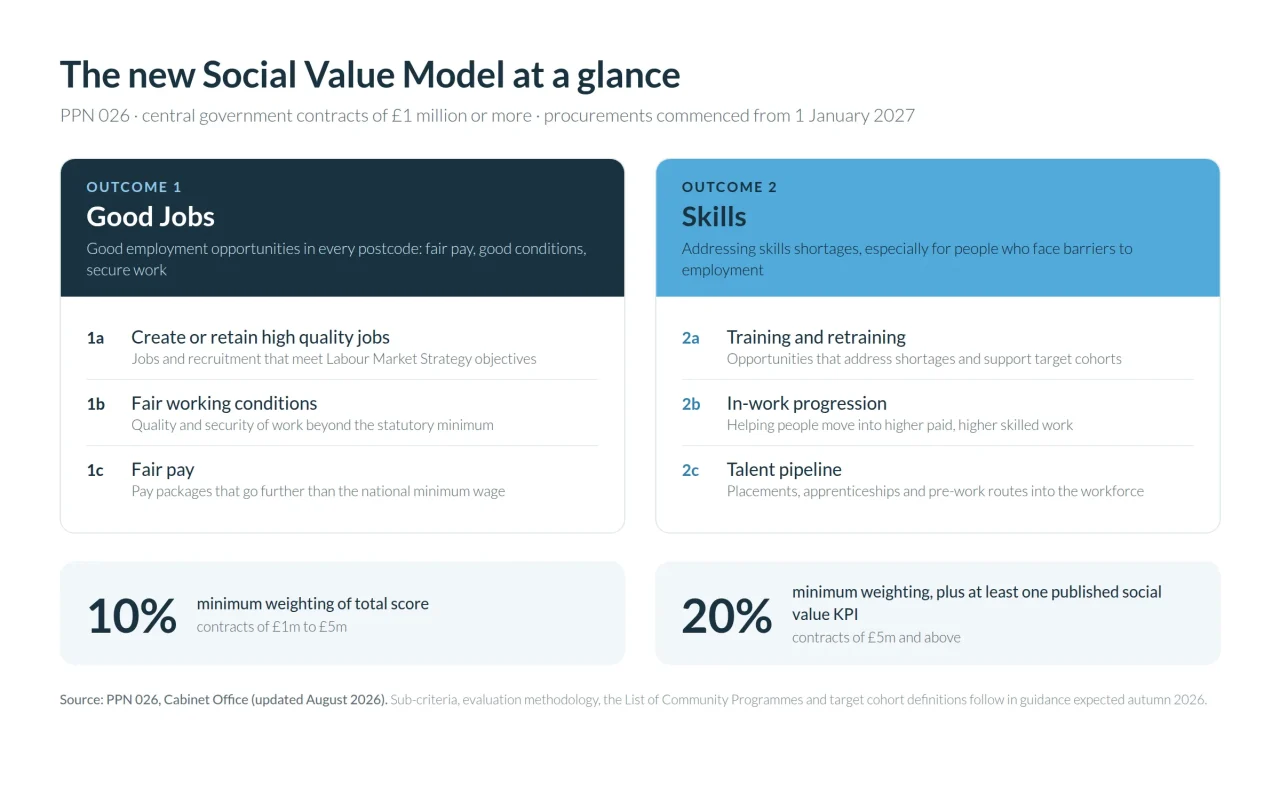
Our explainer covers the mechanics in full, and our comparison with PPN 002 lists the outstanding questions – first and foremost:
- The sub-criteria under each MAC
- The evaluation methodology
- The List of Community Programmes
- The definitions of the target cohorts
We’ll return to these topics in later blogs.
PPN 026 and the Plan to Make Work Pay
Two of the three Good Jobs criteria, fair working conditions (MAC 1b) and fair pay (MAC 1c), are written explicitly in support of the Plan to Make Work Pay.
- 1b. “Promote the wellbeing of workers in the contract workforce in support of the Government’s Plan to Make Work Pay objectives”
- 1c. “Promoting the financial wellbeing of the contract workforce, such as consistent and fair pay, in support of the Government’s objectives set out in the Plan to Make Work Pay”
That plan has now largely become law through the Employment Rights Act 2025 (ERA): much of what suppliers might once have offered as social value, such as banning exploitative zero hours contracts, ending fire and rehire, and day one rights to sick pay and parental leave, is becoming a legal requirement on everyone.
The PPN already points to the consequence. It awards points to suppliers who “offer more than the statutory minimum requirement” and who “go further than the statutory national minimum wage”.
So we should expect the guidance to treat compliance with the ERA as the floor and to score only what sits above it.
Most of what Good Jobs scores sits in employment policy rather than community programmes, which makes it hard to treat as an add-on.
What might sit above it?
The Plan to Make Work Pay suggests some strong candidates:
- Pay benchmarked above legal minimums, where real Living Wage accreditation is a plausible scored differentiator, though nothing in the PPN requires it
- Guaranteed hours and secure contracts ahead of the statutory timetable, since the zero hours provisions phase in through 2027
- Progressive pay and progression policies, which the PPN names directly
- Access to trade union representation and flexible working, both listed in MAC 1b itself
The plan’s enforcement agenda, delivered through the new Fair Work Agency, points to a clean labour market compliance record becoming a hygiene factor rather than a differentiator. And the plan’s longer term direction, including its consultation on a single worker status, suggests the guidance may look favourably on suppliers who extend rights and benefits across their whole contract workforce, not just direct employees.
For contractors, that means gathering subcontractor data in many formats; for firms with salaried, well-paid staff, it is where fair pay differentiation most likely lies.
The Labour Market Strategy and Access to Work
The first Good Jobs criterion, creating or retaining high quality jobs (MAC 1a), asks authorities to consider whether “Labour Market Strategy objectives will be met through the delivery of the contract”.
For clarity: there is no single “Labour Market Strategy” document. So our reading is based on the government’s published labour market programme, principally Get Britain Working, the Youth Guarantee and the ambition of an 80% employment rate.
Those strategies are consistent about where the government wants effort directed: towards people furthest from the labour market. The PPN’s own target cohorts confirm the direction.
They are:
- People not in employment, education or training (NEETs)
- People transitioning from education to employment
- People with a long term health condition or disability
- Care leavers
- “Other communities that face barriers to employment” (to be defined in the guidance)
On that basis, we can expect the guidance to reward recruitment commitments aimed at those specific groups rather than headcount in general, and to look for changed recruitment practice, since the PPN scores suppliers who “adapt their recruitment and retention procedures” to help communities access work.
The programme’s strong local flavour, with employment support increasingly devolved to mayoral areas, suggests place-based commitments tied to where the contract is delivered are likely to score better than national ones.
And given how much of the government’s inactivity problem is health related, expect the long term health condition or disability cohort to carry real weight in the definitions. Scoring well and changing outcomes are not always the same thing, and the published KPI will test the second.
PPN 026 and Skills Strategies
All three Skills criteria, training and retraining (MAC 2a), in-work progression (MAC 2b) and talent pipeline (MAC 2c), are written in support of the government’s “Labour Market and Skills Strategies”.
Again, there is no single “Skills Strategy” document to refer to directly, but the government has issued a detailed set of skills proposals – principally the Post-16 Education and Skills white paper and the Industrial Strategy.
The PPN’s talent pipeline criterion carries the most specific line in the document:
“45 days of work experience is exactly the kind of social value the Prime Minister is seeking to see delivered through this policy.”
Substantial work placements, not token ones, are as close to a confirmed expectation as this exercise allows. The PPN also names its own example of a target skill, “skills for clean energy jobs”, drawn from the skills shortages “set out in government skills strategies”.
Reading the strategies behind those signals, we can expect the guidance to favour:
- Apprenticeships under the new Growth and Skills Levy, with foundation apprenticeships for young people a likely priority given the Youth Guarantee
- Training aligned to the Industrial Strategy’s eight growth sectors, which include Digital and Technologies and Professional and Business Services, and to the shortages Skills England identifies, of which clean energy is the worked example
- Technical education routes, including T Level industry placements, which fit the 45 day signal almost exactly
- Co-designed provision, since the PPN repeatedly scores suppliers who co-design opportunities with communities and anchor institutions such as colleges
The education-to-employment cohort is also the most plausible home of the List of Community Programmes. Tutoring, mentoring and careers activity are the kinds of established programmes a government list could point bidders towards, though how the list will be curated is entirely open.
One practical implication follows either way: where a supplier commits to a listed programme, the PPN already requires the KPI to monitor delivery of that programme, so listed commitments will be contractually tracked from day one. A mentoring programme and a placement scheme, for instance, could both report against one talent pipeline KPI.
It should be borne in mind however that former cabinet minister Alan Milburn is leading a task force due to publish its final report in the autumn on Young People and Work. That’s bound to have an important influence on the wider skills picture.
Three Things to Watch When PPN 026 Guidance Lands
Having said all that, three early tests will tell you how the model will really work:
- Evaulation methodology: Whether points go to quantified volumes, to the quality of the method, or to both, which determines whether bids compete on numbers or narratives. Either way, commitments on a common, auditable basis compare more easily, and Thrive’s Impact Evaluation Standard, overseen by an independent steering committee, provides one.
- List of Community Programmes: How tightly it is curated, who qualifies, and whether listed programmes score differently from a supplier’s own.
- Target cohort definitions: Whether they stay broad or get specific, which decides who benefits.
What to do now
None of the above needs to be confirmed before it is useful:
- Audit your workforce, pay and skills data against the six MACs now, with HR, recruitment and L&D, who hold most of the evidence
- Map what you reported under PPN 002 onto them too, so measures that carry across keep a year-on-year baseline
- Treat draft commitments as provisional but start evidencing them: a published KPI that can count towards exclusion needs each figure tied to its source, such as a payroll record or placement log
- Take exclusion risk to the board: today’s contract performance affects tomorrow’s eligibility, making social value a pipeline investment, not a per-bid cost
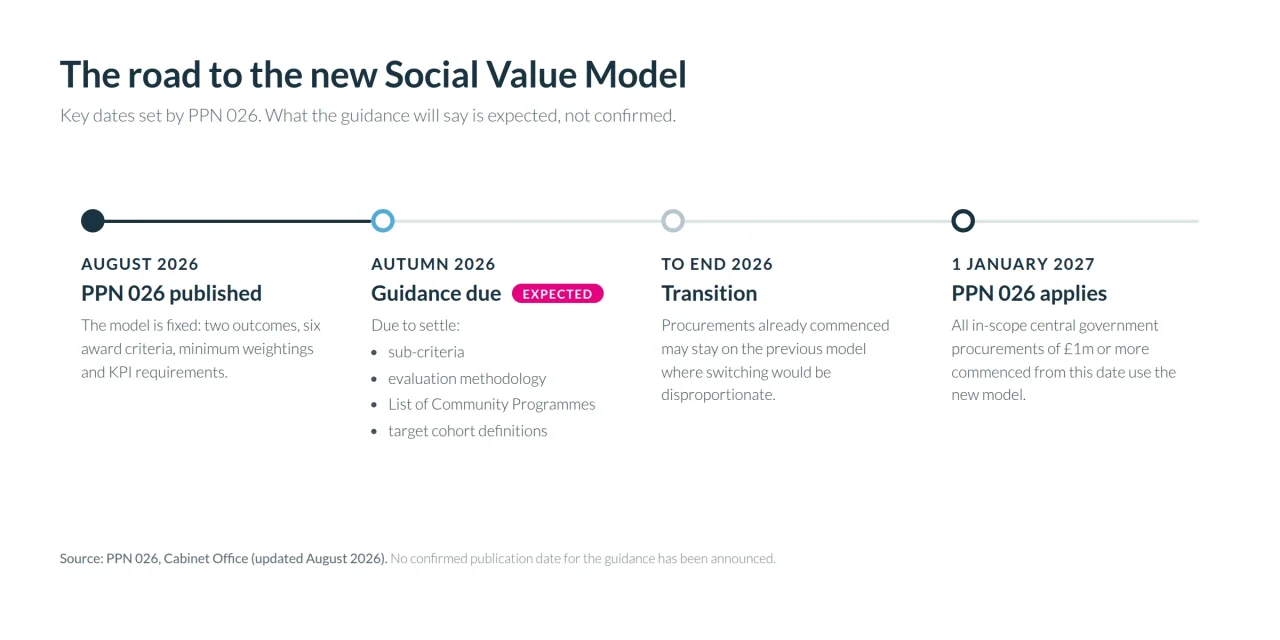
Thrive helps suppliers and contracting authorities measure and report social value credibly. If you want to talk through what PPN 026 readiness looks like for your organisation, book a discovery call.
Questions and answers
PPN 026 says its associated guidance will follow in autumn 2026, and no more precise date has been confirmed. The PPN itself is already in its final form and applies to central government procurements of £1 million or more commenced on or after 1 January 2027, so the guidance is expected to arrive well before the model takes effect.
Four things the PPN defers to it: the sub-criteria that sit under each of the six Model Award Criteria, the evaluation methodology authorities will use to score bids, the List of Community Programmes bidders can support, and the definitions of the target cohorts, including the open category of other communities facing barriers to employment. It will also cover how existing, inherent social value can be taken into account.
Nothing in PPN 026 requires it, and we do not expect the guidance to mandate it. But the fair pay criterion awards points to suppliers who go further than the statutory national minimum wage, and the Plan to Make Work Pay is built around raising the floor on pay, so pay benchmarked above legal minimums is a plausible scored differentiator.
No. The two outcomes, six criteria, weightings, KPI requirement and exclusion risk are already fixed, and they reward evidence over promises. Auditing workforce, pay and skills data against the six criteria, and building the measurement basis for commitments now, will hold whatever the guidance says. The new model tracks fewer outcomes but asks more of each, every year of the contract; preparing now spreads that work. Only the fine detail of scoring should change how bids are written, not whether you prepare.

Alan Boyce
Senior Researcher More articles by Alan >